Best Small Bread Maker UK: A Practical Space and Loaf-Size Guide
Choose a small bread maker for a UK kitchen by measuring its footprint, lid clearance, loaf size and programmes, with a current compact model as a benchmark.
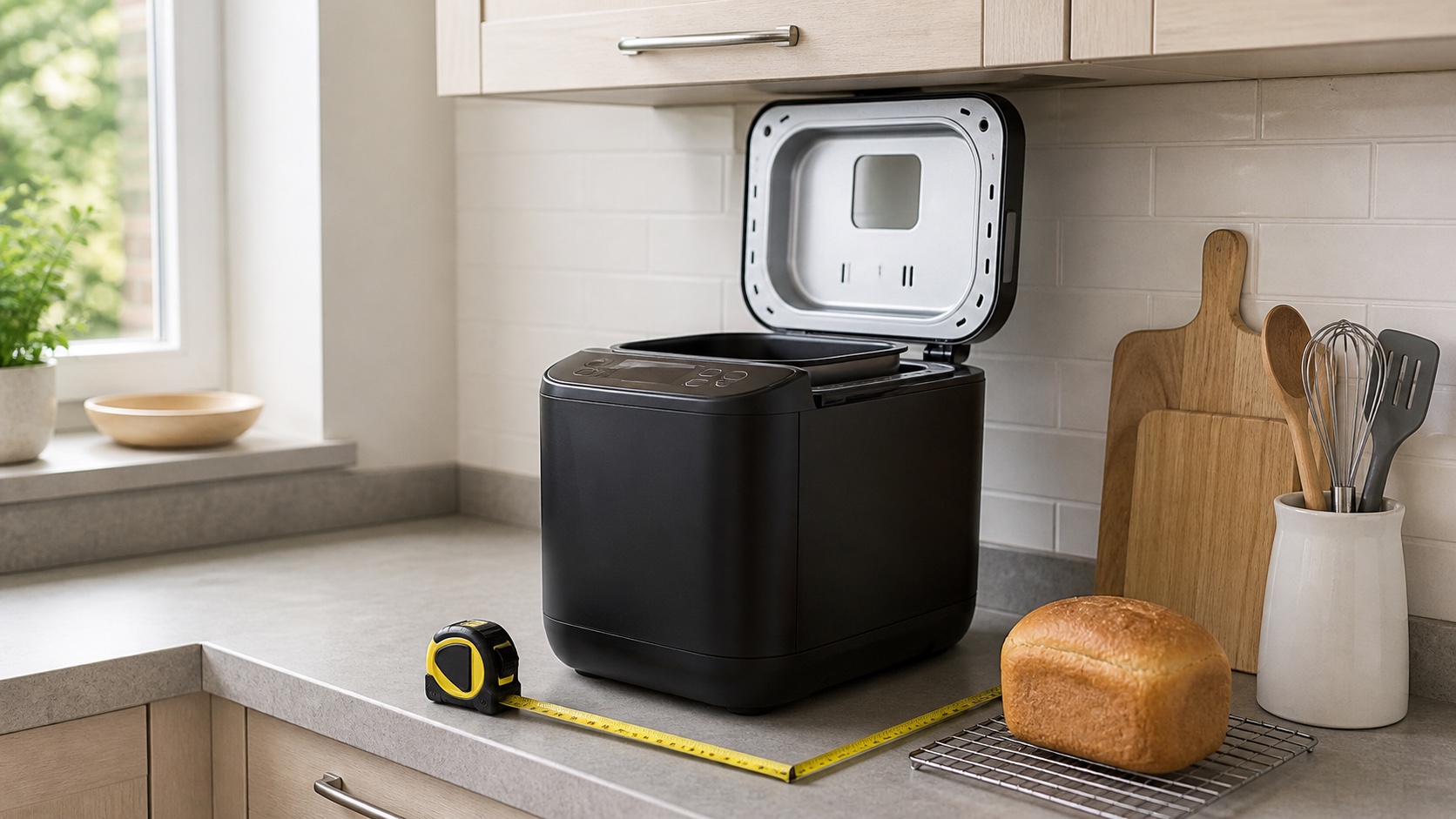
The best small bread maker is not simply the machine with the narrowest body. It is the one that fits your worktop with the lid open, makes a loaf your household will finish, and includes the programmes you will actually use. For one or two people, a genuinely small loaf can reduce leftovers as well as reclaiming cupboard space.
This guide uses published manufacturer dimensions as a benchmark, but it does not pretend that one model suits every kitchen. Measure first, decide what you bake, and then compare the exact model number before ordering.
The quick answer
For a small UK kitchen, shortlist machines that meet all four of these tests:
- The body and open lid fit beneath your wall cupboards.
- The finished loaf is small enough for your normal rate of eating or freezing.
- Your essential programmes are present, including any gluten-free programme you genuinely need.
- The bread pan, paddle and controls are practical to clean and use.
Panasonic’s current SD-PN100 is a useful compact benchmark. Panasonic lists it at approximately 255 mm wide, 307 mm deep and 290 mm high, with an approximately 400 g loaf, 18 automatic programmes and a timer of up to 13 hours. Those numbers are more useful than a retailer calling a machine “mini” without dimensions.
Measure the real operating space
Measure width, depth and height at the socket you intend to use. Then add space for the power lead, ventilation and your hands. The closed height is not enough: a bread maker needs room for its lid to open and for the pan to lift out vertically.
Use masking tape to mark the quoted footprint on the worktop. Put a cereal box or similar object inside the outline and practise opening an imaginary lid. Check whether a cupboard door, splashback rail or low shelf gets in the way. If you intend to store the machine after each bake, include its weight and the route to the cupboard in the decision.
Do not run a hot appliance in an enclosed cupboard. Follow the exact manual for clearances and keep flour away from heating elements and vents.
Small machine versus small loaf
These are different requirements. A narrow machine can still produce a tall loaf that is awkward to slice or toast. A compact-loaf machine may use less flour per bake and better suit a single person, but it will be frustrating for a family that empties a loaf at breakfast.
Panasonic specifies 200 to 280 g of strong bread flour for bread in the SD-PN100 and describes the finished loaf as about 400 g. Treat that as a portion benchmark rather than a promise that every recipe weighs exactly the same. Water, seeds, fruit and flour type change the final weight.
Before buying, estimate how many slices your household uses in two days. If you regularly need a conventional supermarket-loaf quantity, a larger bread maker or two planned bake days may be more sensible than repeatedly running a mini machine.
Programme quality matters more than programme count
A long menu is useful only when it covers your recipes. Write down the three jobs the machine must perform. Common priorities are:
- basic white and wholemeal loaves;
- a rapid programme for late starts;
- dough for rolls or pizza;
- a dedicated gluten-free cycle;
- cake or jam as occasional extras;
- a delay timer for breakfast baking.
The SD-PN100 publishes 18 automatic programmes, including seven bread, four gluten-free, four dough and three sweet options. It has three crust-colour settings and no automatic yeast or raisin-and-nut dispenser. That last point is important: compact dimensions may involve giving up dispensers, so check whether the manual expects ingredients to be added at a signal.
For medically necessary gluten avoidance, a labelled programme does not by itself prevent cross-contamination. Use separate, thoroughly cleaned equipment and follow health-professional and manufacturer guidance appropriate to the household.
Questions that expose a poor fit
Ask these before comparing prices:
| Question | Why it matters |
|---|---|
| What is the exact model number? | Similar names can hide different capacities and programmes. |
| What are the W x D x H dimensions? | “Compact” is not a measurement. |
| How high is it with the lid open? | Closed height does not prove cupboard clearance. |
| What loaf or flour capacity is specified? | This determines portions and recipe limits. |
| Is the pan easy to lift and replace? | A small opening can be awkward for limited grip or reach. |
| Are replacement pans and paddles available? | Wear parts affect the useful life of the appliance. |
| Which programmes can use the timer? | Delayed baking is not suitable for every recipe or ingredient. |
Bread shape, slicing and toasting
Bread-maker loaves are often taller and squarer than shop bread. Let a loaf cool fully before slicing; warm bread compresses and can seem denser than it is. A stable slicing guide and a sharp bread knife can make a small loaf easier to portion.
If toast is part of the plan, compare the cooled slice with your toaster’s usable slot dimensions. If you are still deciding whether compact capacity suits you, compare the broader checklist in our UK bread-maker guide. You can also use the wide-slot toaster guide to measure width, length and depth rather than relying on “wide slot” marketing.
A sensible first-week test
Keep the packaging until you have completed several different bakes within the seller’s return policy.
- Run the manufacturer’s first-use and cleaning steps.
- Make the standard basic loaf exactly as written, weighing ingredients rather than estimating.
- Record the loaf weight, slice count, cycle time and noise that matters in your home.
- Try the programme you bought the machine for, such as wholemeal or gluten-free.
- Check how easily the pan and paddle clean once fully cool.
- Confirm that storage and lid clearance remain convenient in real use.
Change only one recipe variable at a time. Otherwise a poor result cannot be traced to flour, yeast, water temperature, programme or measurement.
What not to overvalue
Do not treat a discount badge, review count or large programme number as proof of fit. Ignore recipe claims that exceed the exact manual’s capacity. A small machine is not automatically quieter, faster or cheaper to run, and a timer is not an instruction to leave perishable ingredients at room temperature overnight.
The strongest purchase is the model whose dimensions, capacity and required programmes are documented and whose loaf matches your household.
FAQ
Is a 400 g loaf enough for two people?
It can be, depending on slice thickness and how often bread is eaten. Count your household’s normal slices over two days and compare that with a trial 400 g shop or homemade loaf.
Does a mini bread maker use less worktop space in every direction?
No. Width may be small while depth, lid swing or cable clearance still causes a problem. Measure the full operating envelope.
Is the Panasonic SD-PN100 the only small bread maker?
No. It is used here because Panasonic publishes clear current UK dimensions, capacity and programme details. Compare any rival by the same evidence standard.
Should I choose a larger model for batch baking?
Usually, yes. If you freeze several loaves or feed a family daily, a larger pan may be more efficient than repeating small cycles.
What should I verify on delivery?
Confirm the model number, plug, included pan and paddle, manual, physical dimensions and damage-free operation before discarding packaging.